
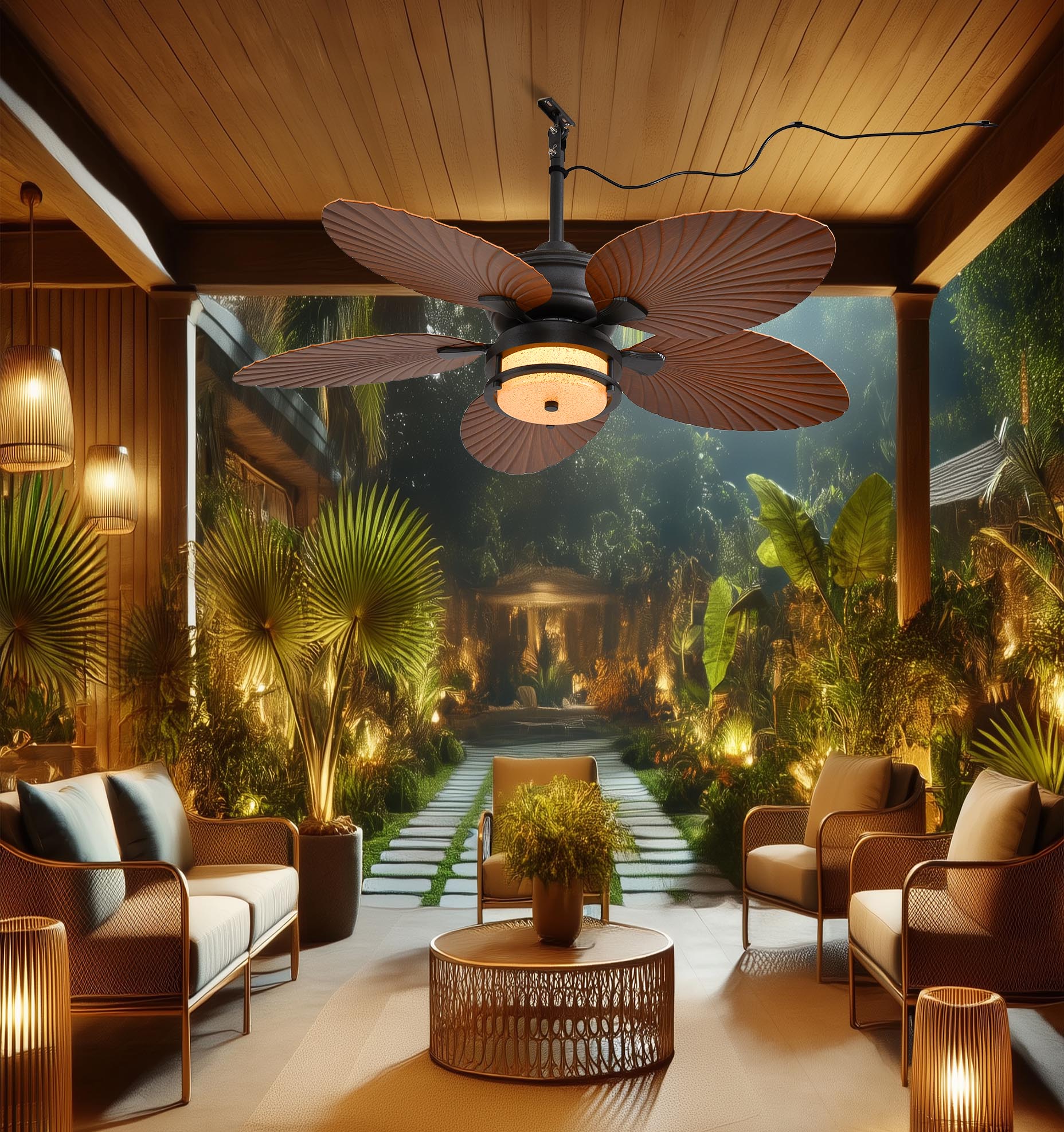
Opening the problem: why efficiency and power both matter
Brands sourcing outdoor cooling and lighting solutions face a clear trade-off: prioritize energy efficiency to lower operating cost, or specify raw motor power to guarantee airflow under heavy load. The decision is particularly acute when buying at scale for venues, resorts, or municipalities where warranty costs and utility bills compound quickly. This piece addresses that gap pragmatically and starts with a concrete procurement scenario—selecting a high-volume outdoor ceiling fan with light for a chain of lakeside pavilions—so procurement leaders can compare lifetime cost, performance, and compliance risks before signing contracts.

Defining the metrics that drive purchase decisions
To make the problem actionable, evaluate three financial and technical metrics: lifecycle energy cost, first-cost (unit + installation), and operational reliability. Lifecycle energy cost converts motor efficiency into dollars per year using estimated run hours; first-cost includes unit price, mounting hardware, and any upgrade to electrical circuits; operational reliability captures maintenance frequency and warranty exposure. Include industry parameters such as CFM (airflow), IP rating for outdoor protection, and lumens for integrated lighting so your comparison reflects both comfort and photometric performance.
A simple case study: two spec sheets, two cost profiles
Consider two candidate units sourced in bulk for a municipal park pavilion. Option A is an efficiency-first model with a high-efficiency DC motor, nominal 6,000 CFM, 120W combined (fan + LED driver), and a wet-rated IP44 housing. Option B is a power-first model with an AC motor, 9,000 CFM peak, 200W combined, and IP54 protection. At first glance, Option B delivers more airflow per unit — useful when pavilion heights are high or frequent large gatherings occur. But annual energy cost for Option B rises materially; over a five-year forecast that difference can eclipse the delta in upfront expenditure. Use a simple present-value comparison with realistic run hours (for example, 2,000 hours/year for busy venues) to make the financial trade-off explicit.

Real-world anchor: what energy data tells us
National energy agencies provide the context for these calculations. The U.S. Energy Information Administration (EIA) reports that residential and small-commercial electricity demand spikes during summer heatwaves, increasing average regional prices and stressing distribution systems—this drives both higher operating costs for power-hungry fixtures and potential utility surcharges during peak events. For procurement, that means energy-efficiency features (CFM/W ratios, efficient motor technology) are not abstract benefits but measurable cost mitigators over contract terms and are particularly relevant for outdoor products like a gazebo fan with light installed in high-use public spaces.
Supplier and specification variables that alter outcomes
Not all suppliers price the same balance. Some vendors bundle dimmable LED drivers and integrated controls (helpful for demand response), while others offer robust blade pitch and heavier-duty bearings to prioritize raw airflow and longevity. You should quantify differences in warranty terms, motor serviceability, and the availability of replacement blades or LED modules. Also, check IP rating nuances—IP44 vs. IP54 matters when a product is exposed to wind-driven rain or coastal salt air. Small specification changes can shift the lifecycle TCO meaningfully—so document those variables before accepting a quote. —
Common procurement mistakes and how to avoid them
Errors recur in three areas: optimistic runtime assumptions, underestimating installation complexity, and insufficient testing with real electrical environments. Buyers often assume lower run hours or ignore peak-hour tariffs; they accept manufacturer-specified CFM without field verification; and they omit a pilot installation to validate dimming performance and electromagnetic compatibility. The practical remedy: require a small pilot batch, specify acceptance tests tied to field CFM measurements, and include clauses for measured energy performance within the contract.
Comparing alternatives: when to choose efficiency or power
Use this quick decision rubric. Choose efficiency-first when: estimated annual run hours are high, grid costs or demand charges are material, and maintenance access is costly. Choose power-first when: ambient conditions (high ceilings, consistent crowding) demand sustained high airflow, or when immediate occupant comfort is mission-critical and utility costs are a secondary concern. Consider hybrid approaches—variable-speed drives or selectable blade kits—to get the best of both worlds without committing to a single extreme. —
Closing advice: three critical evaluation metrics
1) Lifecycle CFM-per-watt (CFM/W): prioritize units with higher CFM/W for long-run cost savings; validate with on-site measurements. 2) Total cost of ownership (TCO) over contract term: include unit, installation, maintenance, replacement parts, and projected energy spend under realistic tariffs. 3) Field-proven reliability and compliance: require evidence of IP rating verification, UL/ETL listings, and warranty terms tied to real operating hours.
These metrics make vendor selection measurable and defensible—and they lead naturally to suppliers that balance efficient motors, verified photometric output, and durable outdoor housings.
— Orison.