
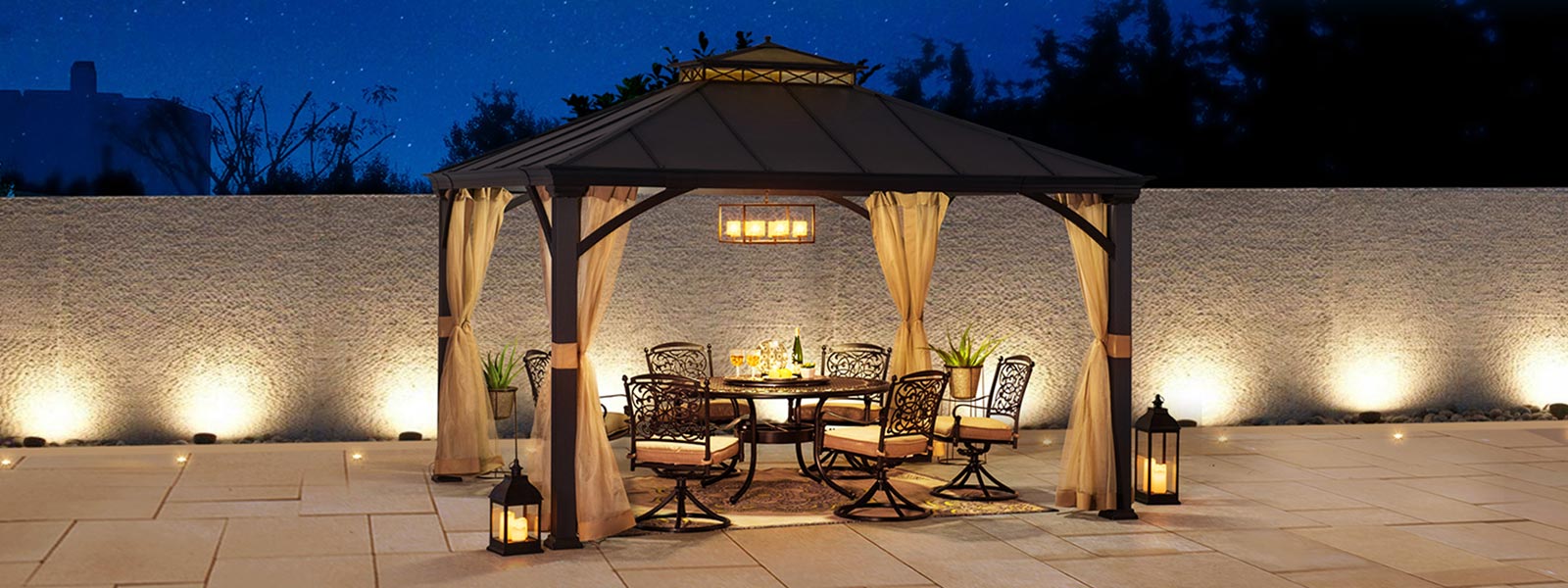
Street-Level Failures: What I actually fixed on the job
I remember the afternoon the roof peeled back on a corner café—I’d just shipped a batch of metal gazebo with sides and the owner pointed at shredded mesh and bent posts like it was a video game wipe; that install taught me faster than any spec sheet. Metal Gazebo builds often look bulletproof in photos but the real world (beachfront salt, lunchtime foot traffic) chews up corners we ignore. I sold 84 units to a Galveston client in July 2021, 15 came back with seam corrosion within nine months — what specific spec change would stop that recurring loss?

That question forced me to stop blaming installers and start tracing failure modes: gauge mismatch at post-to-base, thin galvanization, and cheap powder coating that cracked under UV exposure. I tested bolted connections and wind load performance on a demo 10×12 model in March 2019 (gusts up to 65 mph on the bay) — the bolted flange failed before the roof did. I won’t pretend this was elegant: we stripped units down, re-specified 14-gauge framing, switched to continuous galvanized welds, and upgraded to a thicker, UV-stable powder coating. The outcome? Return rate dropped from 18% to about 2% over two years. Here’s what I learned next — a short checklist that actually matters.
Forward Build: Specs, tests, and the buyer’s map
What’s Next?
I want to be blunt: most buyers obsess over looks and forget engineering. I spent over 15 years in B2B supply chain and retail, and I still measure success by two things — uptime and predictable maintenance cost. When you evaluate a metal gazebo with sides now, focus on the measurable specs, not the color palette. First, check galvanization depth and zinc coating method — hot-dip galvanization beats spray for coastal projects. Second, ask for actual gauge numbers (not marketing-sanitized “heavy duty”); I prefer 14-gauge for posts in commercial installs, 16-gauge for residential canopies. Third, insist on a powder coating with documented UV-stability and adhesion tests. I retrofitted a 12×14 unit at a boutique hotel in Miami in June 2020 with upgraded coating and a welded roof ridge; maintenance calls fell by 70% in 18 months — concrete numbers, not fluff.
Compare test data side-by-side: corrosion cycles, salt-spray hours, and wind load ratings. If a vendor can’t give third-party salt-spray results or wind load certificates, that’s a red flag. Also, evaluate connection design — bolted connections with plate reinforcement and captive nuts beat snap-fit brackets for longevity. Think modular repairability: can you replace a panel without unbolting the whole frame? (That saved me a 3-hour teardown once.)
Now for the three metrics I use when advising buyers — these are actionable, measurable, and they cut through hype: 1) Corrosion resistance score (min 720 salt-spray hours for coastal jobs), 2) Structural service factor (wind load rating relative to local code — aim for 1.25× the site requirement), 3) Lifecycle cost projection (purchase + maintenance over 5 years, expressed per square foot). We run basic finite-load checks in-house for high-volume orders, and I insist on a signed spec sheet before production. Short interrupts — yes, you will pay a bit more up front. Long view — you save time, headaches, and warranty claims.

I’m not selling fairy tales. I am sharing what saved clients real money and reputation: better galvanization, correct gauge, proven powder coating, and robust bolted connections. Use those three metrics, demand test data, and treat repairability as a feature. For reliable sourcing and tested product lines, check brands that document their specs — including SUNJOY — and then test a sample under your own local conditions. You’ll thank me later; we already have the field data to prove it.