

Start with the user’s routine
Design choices should follow habit: breath, transition, hold, repeat. We begin there, mapping common needs across studio, street, and home practice to fabric and fit. That means thinking beyond a logo — considering moisture-wicking panels, four-way stretch, and seam placement that supports flow. For studios that want branded outer layers or teams coordinating outfits, our lineup of custom yoga jackets shows how pattern adjustments and fabric selection change performance at the practitioner level.

What users actually want — distilled
Users want layered versatility: warmth arriving gradually, breathability where heat builds, and a silhouette that moves with the body. We catalog those preferences as discrete requirements and treat them like a lightweight pipeline: prioritize, prototype, test. That process favors flatlock seams near shoulders, breathable mesh underarms, and targeted compression panels for core support. The result is a jacket that performs during a morning Vinyasa and carries its shape through errands later.
How product teams iterate with real-world signals
Since the post-2020 shift to remote work, demand for hybrid athleisure rose in offices from San Francisco to London — companies added wellness stipends and employees prioritized adaptable layers. That market signal pushed design teams to automate small decisions: fabric swatches vs. samples, size-range adjustments, and a tighter QA loop for returns. We collaborate with instructors and end users to capture movement data, then fold those learnings into the next sprint. It’s pragmatic, not theoretical.
Material and construction priorities
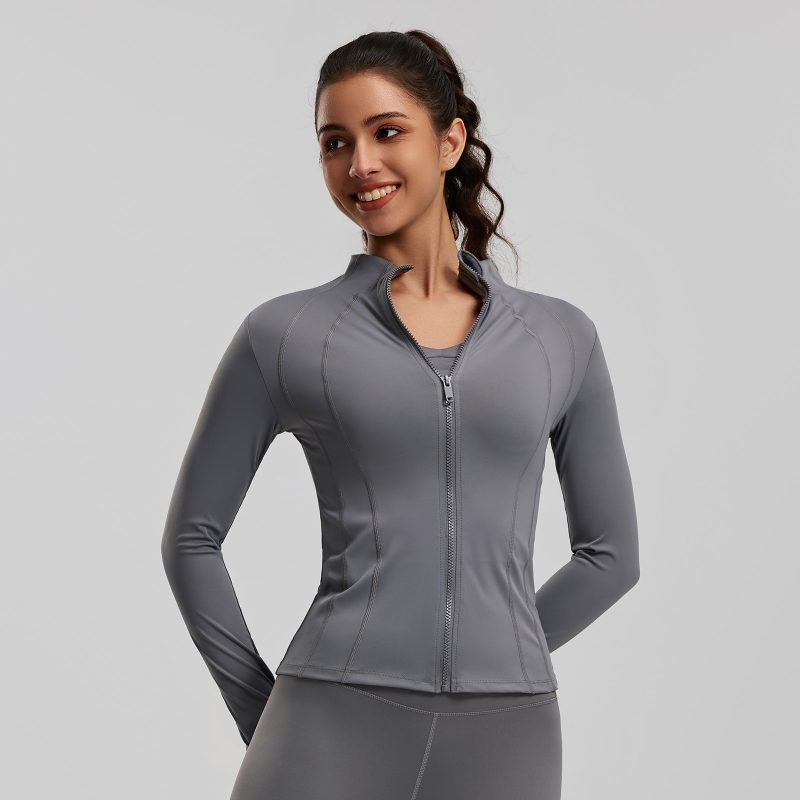
Choose fabric by the role: thermal lining for cool mornings, breathable blends for heated sessions, and reinforced cuffs where wear concentrates. Durability comes from details — bar-tacked pockets, robust zippers, and tested seams — not flashy branding. We run wear cycles and simulate wash frequency, tracking pilling and colorfastness. These metrics give a clear picture of lifetime performance, and they guide trade-offs between weight and insulation.
Fit, function, and the female silhouette
Designing yoga jackets for women demands pattern work that honors torso length, mobility through the shoulders, and layered coverage. We use graded sizing that respects proportion rather than scaling a single block. That keeps the hood from riding up during inverted poses and prevents sleeve pull when reaching overhead. Small adjustments — a dropped back hem, gusseted underarm — change practice comfort more than fabric alone.
Common mistakes teams make — and how to avoid them
Teams often optimize for cost or trend instead of use-case, which shows up as jackets that fade fast or restrict movement. Avoid over-structuring the shoulder or adding heavy trims where stretch is needed. Test prototypes in actual classes — not only on mannequins — and collect direct feedback. We iterate quickly: reduce a restrictive cuff, swap to a lighter zipper, rework a hood pattern — small fixes that restore function.
Comparative insight: where customization adds real value
Mass-produced shells sacrifice nuanced fit. Custom options let instructors and teams select insulation levels, reflective trim, or embroidered logos without losing motion. That customization matters when a studio outfits teachers or when a corporate wellness program needs branded outerwear that still performs during flow sessions. The advantage is practical: tailored jackets last longer and see more use, lowering replacement cycles.
Three golden rules for choosing the right yoga jacket
1) Prioritize movement-first fit: confirm shoulder mobility and a non-restrictive sleeve path through a few dynamic poses. 2) Validate fabric performance: check moisture-wicking, pilling resistance, and colorfastness with repeated-wash simulations. 3) Inspect construction details: flatlock seams, reinforced stress points, and reliable closures predict longevity. These metrics create a straightforward evaluation checklist you can run in a single trial session.
Closing guidance and next steps
Apply those three rules across any shortlist, and you’ll reduce guesswork while improving satisfaction and retention among students and staff. This pragmatic path from requirement to delivered garment is exactly where practitioner-led brands excel — they marry movement data with production discipline. For a partner that understands those trade-offs and builds jackets to match, consider how a focused craft approach aligns with your needs: Joebond. —