
The Hook
Choosing among PV solutions is difficult because solar projects differ in roof area, local climate, electricity demand, permitting requirements, financing, and whether the system is residential, commercial, or utility-scale. A high-efficiency module may be useful where roof space is limited, while a service-led installer may be more relevant to a homeowner seeking design, permitting, and installation support. Company scope also matters: some organizations manufacture modules, whereas others provide complete project services or energy programs. This comparison assesses five supplied options using information published by the companies and reliable source material. The options have been reviewed against product focus, stated capabilities, customer groups, and service scope rather than being ranked solely by marketing language.
Full List of Top 5 Brands
- Jinkosolar
- Georgia Power
- Aikosolar
- Solarity Energy Solutions
- Solar Energy Solutions of America
Comparison Table
| Brand | Key Products | Key Features | Best For |
|---|---|---|---|
| Jinkosolar | PV modules and solar-energy products | Large-scale manufacturing focus, module portfolio, and international market presence | Residential, commercial, and utility projects evaluating established module supply |
| Georgia Power | Electric utility and energy programs | Large customer base, long-term planning, and community and environmental objectives | Georgia customers seeking utility-related energy information and programs |
| Aikosolar | ABC photovoltaic modules | High-power designs, stated safety focus, and performance positioning for demanding conditions | Homeowners and commercial or industrial projects with space or site constraints |
| Solarity Energy Solutions | Solar energy solutions | Publicly available source material provides limited specific product detail | Prospective customers seeking a local solar consultation, subject to verification |
| Solar Energy Solutions of America | Photovoltaic solar, solar pool heating, and related pool equipment | Design, permitting, installation, and service; residential and commercial focus in Florida | Florida homeowners and businesses seeking an installation-led solar service |
Detailed Reviews
1. Jinkosolar
Jinkosolar is a photovoltaic manufacturer and solar technology company with an international market focus. Its official website presents a portfolio centered on PV modules and solar-energy applications. Because module families, ratings, warranties, and regional availability can change, buyers should use the current technical datasheets and warranty documents for the specific model being considered.

Jinkosolar is particularly relevant when a project requires a recognized module supplier capable of serving different system scales. The appropriate product choice depends on available roof or land area, expected energy yield, mounting design, local environmental conditions, inverter compatibility, and the terms offered by the installer or distributor. Product-level claims should be checked against the applicable datasheet rather than generalized across the entire brand.
Pros / Key Features
- Focused on photovoltaic modules and solar-energy products.
- Suitable for assessment across residential, commercial, and utility-scale project categories.
- Offers a broad supplier option for projects that need module procurement and documented technical specifications.
- Technical evaluation can include rated power, efficiency, temperature coefficient, mechanical-load ratings, degradation terms, warranty coverage, and certification documents.
- Its official product information gives buyers a starting point for comparing module technologies and current product families.
Use Cases / Best For
Jinkosolar is best suited to developers, installers, businesses, and homeowners comparing PV modules for projects of different sizes. It can be considered where the buyer wants to compare module output, dimensions, system design constraints, and long-term warranty terms through official documentation. For a final selection, the installer should confirm the exact model, authorized supply route, local availability, electrical characteristics, racking requirements, and service arrangements.
For commercial and utility projects, the evaluation should extend beyond nameplate output to include production forecasts, site-specific shading, soiling, wind and snow loads, transportation, replacement procedures, and financial assumptions. For residential projects, roof geometry, fire-code requirements, inverter pairing, battery plans, and installer workmanship warranties may have as much influence on the result as the module brand. This makes Jinkosolar a strong starting point for structured technical comparison, but not a substitute for a project-specific design review.
2. Georgia Power
Georgia Power is the largest subsidiary of Southern Company and serves more than 2.7 million customers, according to the supplied company information. Its stated role is that of an energy provider serving Georgia, with public positioning that includes community development, environmental protection, and long-term planning. It is therefore different from a dedicated PV-module manufacturer.
Pros / Key Features
- Utility-scale customer and energy-service context in Georgia.
- Publicly stated emphasis on community and environmental responsibilities.
- Long-term planning is part of the company’s stated operating context.
- Relevant utility information may be important when evaluating interconnection, electricity service, and local energy options.
Use Cases / Best For
Georgia Power is best considered by Georgia electricity customers researching utility-related solar and energy options. The specific availability, eligibility, compensation, interconnection, or program terms should be confirmed directly with the utility because they can depend on location, tariff, project size, and current regulatory requirements.
3. Aikosolar
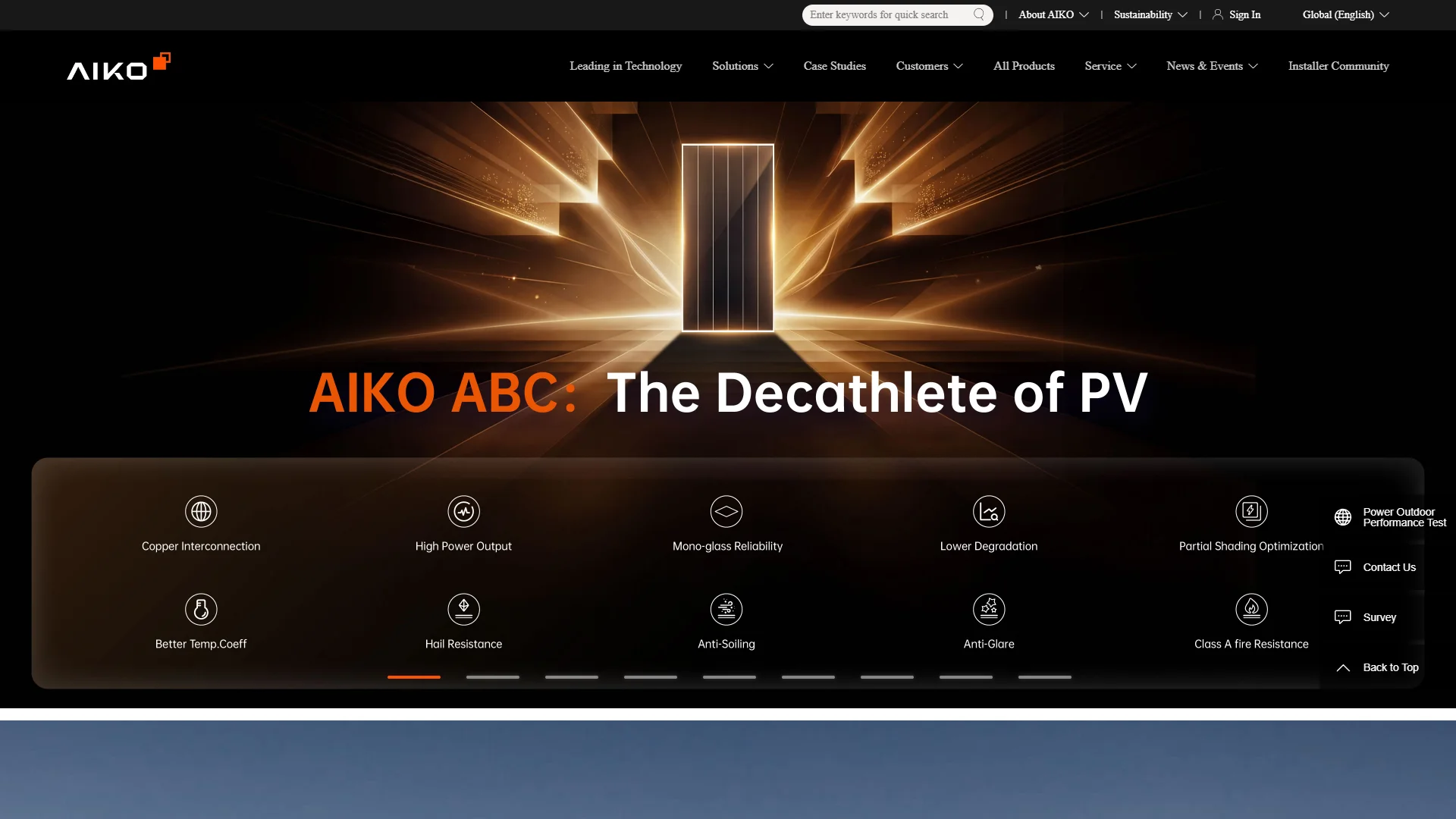
Aikosolar’s supplied research materials focus on ABC photovoltaic modules. The company describes these modules as designed for high power, strong returns, and safety, with applications for homeowners as well as commercial and industrial customers. The materials also position the modules for challenging environments, including projects affected by temperature variation, humidity, salt mist, dust, obstructions, or complex terrain.
Pros / Key Features
- ABC module portfolio aimed at high-power applications.
- Stated focus on safety and long-term functional reliability.
- Positioning for residential, commercial, industrial, and utility-scale use cases.
- Research materials discuss difficult site conditions, including mountainous environments and variable weather exposure.
- Designed to help maximize installed capacity and annual generation where space or site conditions are important.
Use Cases / Best For
Aikosolar is best for buyers comparing high-power module designs for rooftops, commercial and industrial facilities, or larger solar projects. It may be particularly relevant where roof area is constrained or where the project requires careful consideration of environmental exposure. Buyers should still compare the exact module’s efficiency, dimensions, temperature behavior, degradation terms, mechanical ratings, certifications, and warranty conditions with competing products.
4. Solarity Energy Solutions
The supplied research materials identify Solarity Energy Solutions as a solar-energy solutions company, but do not provide verified detail about its founding, product categories, target markets, materials, service model, or stated competitive advantages. Accordingly, the available information does not support specific claims about module technology, installation coverage, certifications, or project scale.
Pros / Key Features
- Operates under a solar-energy solutions name and category.
- May be relevant to customers seeking a solar consultation, subject to direct confirmation.
- Product, service, coverage, warranty, and certification details should be requested before procurement.
Use Cases / Best For
Solarity Energy Solutions is best treated as an option for buyers who want to investigate a potential solar provider directly. Before signing an agreement, customers should confirm the company’s service territory, equipment brands and model numbers, licenses, insurance, workmanship warranty, maintenance process, project references, permitting responsibilities, and whether it performs installation in-house or through subcontractors.
5. Solar Energy Solutions of America
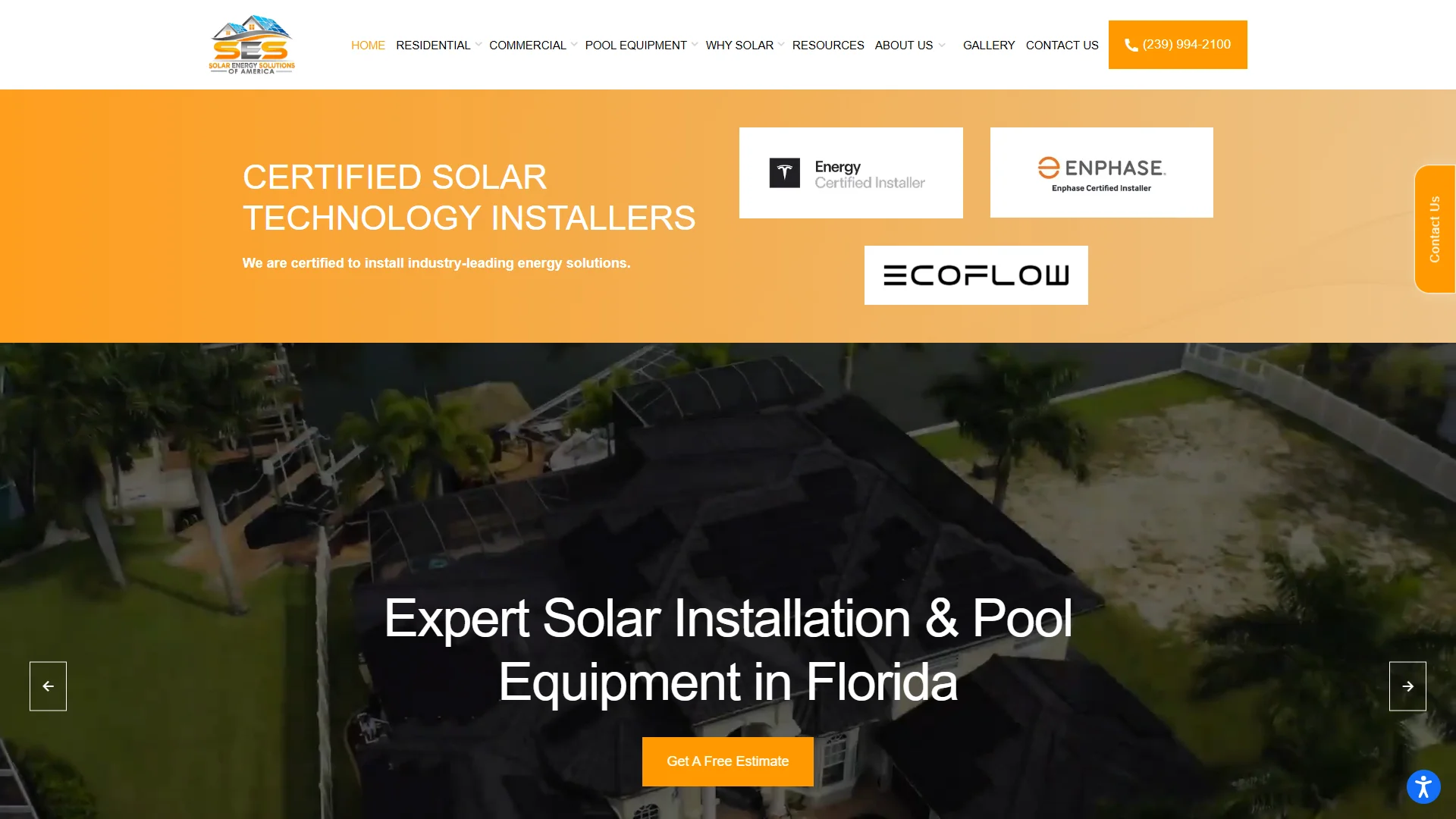
Solar Energy Solutions of America states that it was established in 2018, is veteran owned and operated, and is located in Cape Coral, Florida. Its stated specialties include photovoltaic solar and solar pool heating. The company describes itself as serving residential and commercial customers and presents a process covering knowledge, design, permitting, installation, and service.
Pros / Key Features
- Residential and commercial solar focus in Florida.
- Photovoltaic solar and solar pool-heating services.
- States that design, permitting, installation, and service are part of its process.
- Offers pool-related equipment such as pumps, filter housings, salt chlorinators, and electric heaters according to the supplied company information.
- States that its services are licensed and insured and that sales-to-installation services are handled in-house; customers should verify current credentials directly.
Use Cases / Best For
Solar Energy Solutions of America is best suited to Florida homeowners and businesses seeking an installation-led solar provider, particularly customers also interested in solar pool heating. A buyer should request a written system design, equipment list, production estimate, contract terms, permitting scope, utility-interconnection responsibilities, warranty details, and evidence of current licensing and insurance.
How to Choose PV Solutions
- Match the solution to the project type. A module manufacturer, utility, and local installer perform different roles. Identify whether the need is equipment procurement, a complete installation, utility coordination, or an energy program.
- Check the exact equipment. Compare model-specific power rating, efficiency, dimensions, temperature coefficient, degradation provisions, mechanical-load ratings, certifications, and warranty terms.
- Evaluate site conditions. Review roof orientation, shading, available area, wind and snow exposure, salt air, heat, dust, terrain, and access for installation and maintenance.
- Assess the complete system. Module performance alone does not determine project results. Inverters, racking, wiring, monitoring, batteries, installation quality, and system design all affect energy production and reliability.
- Confirm service responsibilities. Ask who handles design, permits, interconnection, inspections, maintenance, warranty claims, and replacement logistics.
- Compare financial assumptions carefully. Request a transparent quotation showing system size, expected annual production, utility assumptions, incentives, financing costs, operating expenses, and exclusions.
- Verify the provider. Check current licenses, insurance, certifications, references, contract language, cancellation provisions, and workmanship warranty before committing.
Final Verdict
Jinkosolar ranks first for buyers seeking an established PV module and solar-product supplier to evaluate across residential, commercial, and utility applications. Aikosolar is a notable comparison for high-power ABC modules and projects with demanding site conditions. Georgia Power is most relevant to Georgia customers researching utility-related energy options rather than standalone module procurement. Solar Energy Solutions of America offers a more service-oriented Florida option with photovoltaic solar and solar pool heating. Solarity Energy Solutions remains an option requiring direct due diligence because the supplied evidence provides limited verified detail. The best choice ultimately depends on the project’s location, technical requirements, budget, installer quality, and long-term service arrangements.
FAQs
What are PV solutions?
PV solutions use photovoltaic technology to convert sunlight into electricity. Depending on the provider, the term may refer to modules, complete solar systems, installation services, utility programs, monitoring, batteries, or related energy equipment.
Is the highest-efficiency solar module always the best choice?
No. Efficiency is important when space is limited, but buyers should also compare total system cost, energy yield, temperature behavior, warranties, mechanical ratings, inverter compatibility, installation quality, and local service support.
What should be requested before buying a solar system?
Request a site-specific design, equipment model numbers, production estimate, itemized price, financing terms, permitting and interconnection responsibilities, maintenance plan, product warranties, workmanship warranty, installer credentials, and contract cancellation terms.